Humanity and the Cosmos: The Eternal Dialogue Between Man and the Universe
The cosmos will always remain the cosmos,
and man will forever remain only a man.
He will grow ever more experienced,
yet no amount of experience will suffice
to make him feel at home in the cosmos.
— Arkady and Boris Strugatsky, The Kid
Under the Silent Guardianship of Galaxies
In the vast expanse of cosmic haze, distant and dim, glimmers the planet of humankind.
It breathes and endures through billions of years, beneath the mysterious and unseen guardianship of galaxies — along whose stellar paths the Universe itself guides humanity with cryptic signals, as if asking, or perhaps waiting for an answer across eternity. The Universe — the primordial mother of all that exists, both subtle and material, comprehensible and unreachable — and Earth is but one of her many children. Perhaps not the most successful, nor the most radiant; it is uncertain whether beloved, but certainly — curious.
In its childlike curiosity, with the ease and openness of youth, humankind constructs a symbolic world of knowledge.
Its defenseless cities, exposed beneath the open sky, live their brief lives measured in flashes of light — filling the void with towers risen to celestial heights, the hum of endless dialogue, the flicker of everyday dramas, and the disposable joys of passing days. Amid these tangled masses, humanity, a collective cosmogonic child, searches each day for a smaller meaning — one that leads toward the truth of being, that lends essence to the brief segment of the earthly journey.
The Second Birth of the Universe
Transport grids, communication webs, laboratories of high science, theories of economies and social constructs, religious dogmas, and the intricate architectures of political systems — all form a massive, steep staircase upon which, in the human imagination, one might ascend toward the ultimate comprehension of existence. Perhaps, reaching the final step with a weary foot hardened by the journey, humanity will at last answer the central question of its presence on this planet — the meaning of its connection with outer worlds — and formulate the only possible message to send beyond.
The complexly woven world, through the succession of faces and generations, fashions and philosophies, architectures and technologies, joys and sorrows, crowned victories and the ruins of disgraceful, bloody wars — has always gazed toward a single point of meaning: the desire to immortalize its own significance within the unreachable cosmic distances, there where all things once seemed to begin, at the zero mark upon the coordinates of eternity.
If no material trace is left behind, no word transmitted, not even a fragment of condensed energy sent as a message to the higher worlds — humanity loses its foundation and cannot exist, sinking into a sequence of purely mechanical acts aimed only at maintaining physical survival. And thus, our experiments, our efforts to expand the boundaries of the possible, our discoveries, and our striving to transcend the biological, all lose their meaning.
What we do — is what the Universe itself does in the place we call “here and now.” Only here and only now does everything hold meaning for us; only here and now can we rejoice and grieve, believe and hope.
And man lives by hope — breathes it, consumes it, as the very flesh and blood of Life itself. Thus, every small replica of humanity — every individual, talented or dull, whole or fragmented in contradiction, luminous or dark — repeats, century after century, the same simple routine, gazing with boundless hope into the post-stratospheric distance. Toward that horizon, for which, at the cost of destiny, through immense effort, technological triumphs, revolutions in art, and the discovery of new spiritual frontiers, humanity must send at least a brief message — a signal, a visiting card of its existence, though transient and fragile.
What would happen if humanity were to gather, on a planetary scale, the total force of billions of souls, the warmth of all physical bodies, and the passion of every heart — multiplying this capital by technological progress and raising it to the high degree of artificial intelligence capable of solving the most intricate problems and summing up the entire accumulated experience of the planet? What would come to pass if the people of Earth could merge the light of the Universe allotted to each at birth, fading at death, into one unified beam?
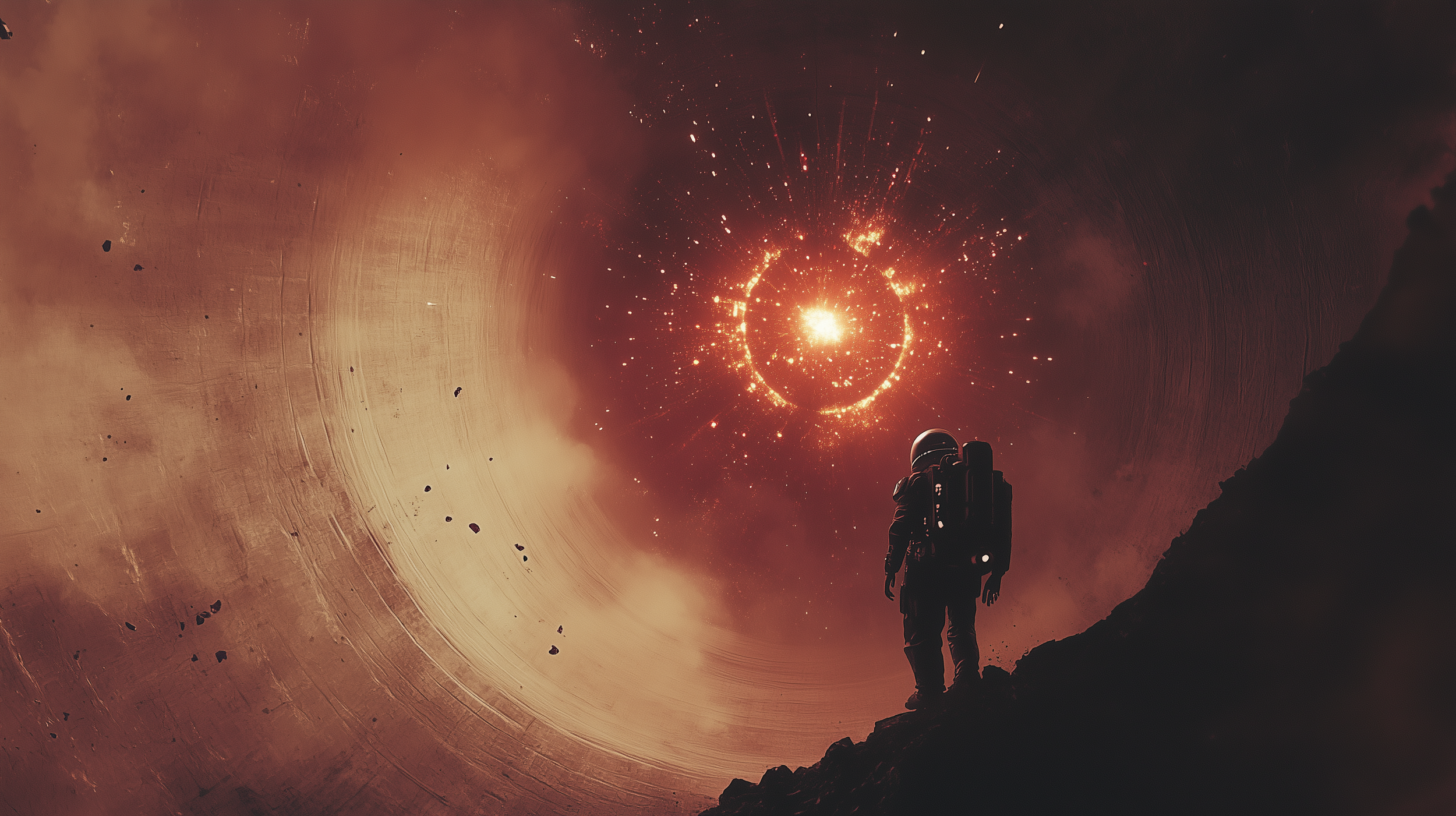
Perhaps, uniting all of this, we could conceive the second great explosion in the history of the Universe — this time, a man-made, informational Big Bang 2.0, born of the immense desire to touch eternity in any perceptible way. The energy of this mighty event might reach the silence of Eternity, echo within it, and dissolve into the existential dusk — briefly but brightly declaring its existence. The oscillations of souls, the torments of the heart, the trials of will, the ecstasies of inspiration and the anguish of disappointment — all would, for an instant, draw the attention of Eternity, scattering like starlight across the heavens.
The discreteness of these oscillations might compel Eternity, for fractions of light-seconds, to turn its gaze toward one of its symbolic children — toward Humanity. The Universe, in a single moment, would read billions of volumes of our history. If fate were unimaginably kind, it might hear the babble of infants and the laughter of children, the roar of the sea and the rustle of leaves carried across the static of space; it might see eyes filled with both hope and sorrow; it might sense the faint fragrance of the magical flowers it once conceived itself — now pushing through the petrified, neon-lit jungles of Earth’s megacities. Billions of digital codes, in a single line, would reflect in Eternity — and be inscribed in its inward gaze.
We would accomplish the impossible — we would remain forever.
And one day, when Earth lives its final hour, pressing its cooling brow against the flaming glow of the sunset, somewhere far away — on the outskirts of the last city — in the pathos of simplicity, a flower will bloom: ordinary, earthly, fragile. Humanity, having given all its light to the Universe, will find its final refuge in the flickering discreteness of time, where faces replace faces, and the pure gaze of a child turns into the dimmed eyes of an elder faster than the thought of it can cross the space of life and reach, as a final word, the hearing of the galaxies.
12.10.2025Designed for thinkers.